Best Stihl Chainsaw Models for Homeowners and Professionals
Stihl has been making chainsaws since 1926, and there’s a reason they’re still the first brand most experienced cutters recommend. The quality is consistent, the dealer support is real, and the saws hold up under serious use. But with over a dozen models in their current lineup, figuring out which one fits your situation takes more than just picking the most popular name.
I’ve run Stihl saws for years on my Montana property — from clearing deadfall after storms to splitting firewood through the fall. If you’re comparing the best chainsaws for homeowners and keep landing on Stihl, you’re already thinking in the right direction. This guide breaks down the seven models worth your attention, matched to the work you’re actually going to do.
One heads-up before we dive in: Stihl restricts their authorized dealers and limits third-party online sales. Some models aren’t available through Amazon. Where that’s the case, I’ve noted it and pointed you toward authorized dealer options instead.
Quick-Picks Comparison Table
| Model | Best For | Engine / Power | Bar Length (std.) | Weight (lbs) | Our Rating |
|---|---|---|---|---|---|
| Stihl MS 170 | Light homeowner use | 30.1 cc | 12–16 in | 8.6 lbs | 4/5 |
| Stihl MS 211 | Mid-range homeowner | 35.2 cc | 14–16 in | 9.5 lbs | 4/5 |
| Stihl MS 250 | Homeowner/Pro crossover | 45.4 cc | 16–18 in | 10.1 lbs | 4.5/5 |
| Stihl MS 271 Farm Boss | Serious homeowners / farm use | 50.2 cc | 18–20 in | 12.3 lbs | 4.5/5 |
| Stihl MS 391 | Heavy homeowner / light pro | 64.1 cc | 20–25 in | 13.2 lbs | 4.5/5 |
| Stihl MS 461 | Professional logging / land clearing | 76.5 cc | 20–28 in | 15.2 lbs | 5/5 |
| Stihl MSA 220 C-B | Battery-powered homeowner use | 36V AK system | 14–16 in | 7.7 lbs (no battery) | 4/5 |
What to Look For in a Stihl Chainsaw
Stihl makes saws for everyone from the occasional weekend trimmer to the full-time logger. Before you spend money, get clear on a few key specs that actually determine whether a saw fits your work.
Engine Size and Power (cc)
Displacement in cubic centimeters (cc) is the most honest indicator of what a gas chainsaw can handle. A 30–35 cc saw is fine for trimming limbs and cutting small rounds. Once you’re felling trees over 10 inches in diameter or processing firewood regularly, you want at least 45–50 cc. Pro work — logging, land clearing, milling — typically starts at 60+ cc. Buying too small a saw and pushing it hard will burn it out faster and make the work harder than it needs to be.
Bar Length
Bar length sets the maximum diameter of wood you can cut in a single pass. A 16-inch bar handles most homeowner tasks comfortably. A 20-inch bar opens up firewood cutting and medium tree felling without going overboard. Going longer than you need adds weight and makes the saw harder to control, especially for beginners. Check out our full guide on how to choose the right chainsaw bar length if you want the full breakdown by use case.
Gas vs. Battery (Stihl MSA Series)
Stihl’s AK and AP battery systems have gotten genuinely capable over the last few years. Battery saws start instantly, run quieter, require less maintenance, and are easier to store. The tradeoff is runtime — you’re working in battery intervals rather than just refilling a tank. For light homeowner use (under an hour of cutting at a time), a battery saw is a real option. For sustained cutting or remote property work where charging isn’t practical, stick with gas.
Weight and Ergonomics
Weight matters more than most buyers realize until they’re an hour into cutting. An extra two pounds feels like ten after a full morning of work. Overhead cuts for limbing, working on a ladder, or cutting at awkward angles all get harder with a heavier saw. Stihl’s anti-vibration system (AV) also varies by model — the better the AV system, the less fatigue you’ll carry in your hands and arms at the end of the day.
Safety Features to Look For
Every Stihl gas saw ships with an inertia-activated chain brake — it stops the chain automatically if the saw kicks back toward you. That’s the most important safety feature on any chainsaw. Anti-vibration dampeners reduce long-term nerve damage risk. A chain catcher helps if the chain throws or breaks. If you’re new to chainsaws, these aren’t optional upgrades — they’re the minimum. Make sure whatever model you buy includes all three.
Best Stihl Chainsaws: Reviews
Here are the seven Stihl models worth your attention in 2024, ordered from lightest-use to most powerful. Each one has a clear place in the lineup — none of them are bad saws, they’re just built for different jobs.
Stihl MS 170 — Best for Light Homeowner Use
The MS 170 is Stihl’s entry-level gas saw, and it’s been the go-to recommendation for first-time buyers for good reason. It’s lightweight, easy to start, and handles the tasks most homeowners actually face: trimming branches, cutting small rounds, clearing brush. At 30.1 cc and typically fitted with a 12–16 inch bar, it’s not going to tackle anything over 12 inches in diameter comfortably — but that’s not what it’s for.
The saw runs clean, starts reliably with a few pulls, and the low weight makes it manageable for people who aren’t used to running a chainsaw all day. The anti-vibration system is basic compared to higher-end models, so you’ll feel more buzz in your hands during extended use. For occasional weekend tasks, that’s not a dealbreaker.
One honest note: the MS 170 is a consumer-tier saw. It’s not built for regular, heavy use. If you’re cutting firewood for a wood stove throughout the fall, step up to the MS 271. But if you need a reliable saw for a few hours a month, this one punches above its price.
Available at authorized Stihl dealers. Use the Stihl dealer locator to find one near you.
Pros
- Lightest gas saw in the Stihl lineup at 8.6 lbs
- Easy starting for beginners
- Low purchase price for the quality
- Reliable for light, occasional use
Cons
- Underpowered for regular firewood cutting
- Basic anti-vibration system
- Not suited for wood over 10–12 inches in diameter
Stihl MS 211 — Best Mid-Range Homeowner Saw
The MS 211 sits between the entry-level MS 170 and the more capable MS 250, and it hits a sweet spot for homeowners who use their saw more than a few times a year. The 35.2 cc engine gives it noticeably more grunt than the MS 170, and it handles 14–16 inch bars with more confidence. Stihl also gave this model a better anti-vibration system, which you’ll notice on longer cutting sessions.
This is a solid choice if you’re clearing storm damage regularly, cutting mid-sized limbs, or doing occasional firewood rounds on smaller-diameter wood. It’s still a consumer-grade saw, but it handles moderate use without complaint. The controls are clean and intuitive — Stihl’s ergonomics are consistently better than competitors in this price range.
Pros
- More power than the MS 170 without a big weight increase
- Improved anti-vibration system
- Good fit for homeowners who cut several times a year
Cons
- Still limited for large-diameter timber
- Not available through Amazon — dealer purchase required
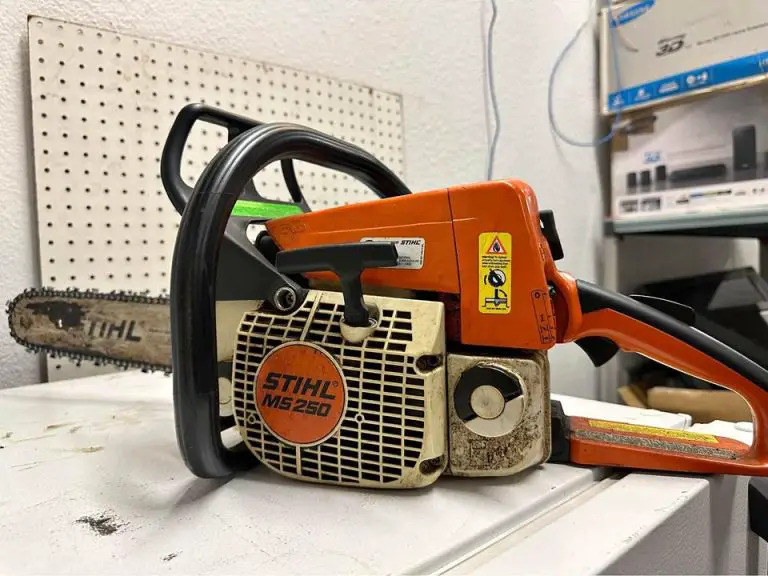
Stihl MS 250 — Best All-Around Homeowner/Pro Crossover
The MS 250 is one of the most popular saws Stihl makes, and that’s not an accident. At 45.4 cc, it has enough power to handle most homeowner tasks and even light professional work without feeling overwhelmed. A 16–18 inch bar covers the vast majority of tree felling and firewood cutting that a non-commercial user will ever do.
What I like about this saw is the balance. It’s not too heavy at 10.1 lbs, starts easily, runs cleanly, and the 2-MIX engine gives it better fuel efficiency and lower emissions than older Stihl motors. If you’re looking for one saw that handles nearly everything around the property, this is the one I’d hand to most people.
Pros
- Versatile enough for homeowners and light pro work
- 2-MIX engine improves fuel efficiency
- Good power-to-weight ratio
- Handles 16–18 inch bars comfortably
Cons
- Pricier than entry-level options
- May feel like overkill for very light, infrequent use
Stihl MS 271 Farm Boss — Best for Serious Homeowners
The Farm Boss has been a ranch and property staple for years, and it earns that reputation every season. The 50.2 cc engine is paired with an 18–20 inch bar as standard, which means it handles real firewood cutting, mid-sized tree felling, and property management work without breaking a sweat. This is the saw I’d point any serious homeowner toward if they’re processing a cord or more of firewood a year.
The pre-separation air filtration system extends filter life and reduces maintenance intervals — that matters on a saw you’re running hard. The chain lubrication is reliable, the anti-vibration system is noticeably better than the consumer-tier models, and the ergonomics work well for all-day cutting. If you want to know more about getting the most out of a saw like this, our guide on how to cut firewood with a chainsaw covers technique from start to finish.
Pros
- 50.2 cc handles real firewood and felling work
- Pre-separation air filtration reduces maintenance
- Excellent power-to-weight balance for its class
- Built for regular, sustained use
Cons
- Heavier than mid-range consumer saws at 12.3 lbs
- More saw than a casual user needs
Stihl MS 391 — Best for Heavy Homeowner/Light Pro Use
The MS 391 steps up to 64.1 cc and accepts bars up to 25 inches, which puts it firmly in the territory of larger timber and production cutting. This is the saw for someone who’s clearing land, working larger trees regularly, or doing part-time arborist or firewood work. It’s a substantial saw at 13.2 lbs, but the power output justifies the weight once you’re cutting through wood over 18 inches in diameter.
Stihl’s Ematic chain lubrication system on this model reduces bar oil consumption by up to 50% compared to older designs — that’s a real cost savings over time if you’re running it regularly. The 2-MIX engine keeps emissions in check. This is a serious tool and priced accordingly, but it’s the right choice for anyone whose cutting demands have outgrown the Farm Boss.
Pros
- 64.1 cc handles large timber with ease
- Ematic lubrication reduces bar oil consumption
- Accepts up to 25-inch bar
- Good bridge between homeowner and pro-grade
Cons
- Heavier than most homeowners need
- Higher price point
Stihl MS 461 — Best Professional Gas Chainsaw
The MS 461 is a pro-grade saw built for loggers, arborists, and land clearing operations. At 76.5 cc and up to a 28-inch bar, it handles timber that would stall a lesser saw outright. The magnesium engine housing keeps the weight manageable at 15.2 lbs for what it is, and Stihl’s M-Tronic engine management system automatically adjusts fuel and ignition settings to account for altitude, temperature, and fuel quality — which matters when you’re working all day in variable conditions.
This isn’t a saw most homeowners need. But if you’re clearing significant acreage, working as a professional, or running a saw for hours every day, the MS 461 is built to handle that load without faltering. It’s an investment that pays back in reliability and longevity when you’re actually putting it to work at that level.
Pros
- 76.5 cc — handles the biggest timber jobs
- M-Tronic automatic engine management
- Built for all-day professional use
- Magnesium housing keeps weight reasonable for its class
Cons
- Significant cost — pro-grade price
- Overkill for homeowners and occasional users
- Heavier than mid-range models
Stihl MSA 220 C-B — Best Battery-Powered Stihl
The MSA 220 C-B is the top of Stihl’s AK battery system and the model I’d recommend for homeowners who want a capable saw without dealing with gas, oil mixing, or carb maintenance. It’s genuinely quiet compared to any gas saw, which matters if you have neighbors close by or you’re working early in the morning. At 7.7 lbs without the battery, it’s also the lightest saw on this list.
Runtime depends on the battery — the AK 30 gives you lighter cutting, the AK 10 gives you more extended sessions. Stihl’s battery platform is compatible across their cordless tool line, so if you already own AK system tools, the MSA 220 C-B becomes even easier to justify. For anyone considering the battery route, our rundown of the best battery-powered chainsaws covers how Stihl stacks up against the competition.
Pros
- No gas, no oil mixing, no carb issues
- Lightest saw on this list at 7.7 lbs (no battery)
- Quiet operation — neighbor and early-morning friendly
- Compatible with Stihl AK battery system
Cons
- Runtime limited by battery capacity
- Battery and charger sold separately
- Not practical for remote cutting far from power
Frequently Asked Questions
What is the best Stihl chainsaw for a homeowner?
For most homeowners, the Stihl MS 250 or MS 271 Farm Boss covers the full range of typical property tasks. The MS 250 is the better pick if you cut occasionally and need a versatile all-rounder. The Farm Boss is the better choice if you’re processing a cord or more of firewood each fall or managing a larger property with regular cutting. If you want the simplest possible experience with minimal maintenance, the MSA 220 C-B battery saw is worth a look for light use.
What’s the difference between the Stihl MS 170 and MS 211?
The MS 170 is Stihl’s lightest, most affordable gas saw — it’s built for occasional light use like trimming and small branch removal. The MS 211 gives you about 5 more cc of displacement, a better anti-vibration system, and more confidence cutting slightly larger wood. If you’re using the saw a handful of times a year for minor tasks, the MS 170 is fine. If you’re cutting a few times a month or dealing with wood over 8 inches regularly, the MS 211 is the better investment.
Are Stihl chainsaws worth the money?
Yes — with one caveat. You need to use the saw enough to justify the cost. Stihl builds to a higher standard than most mass-market brands, and their saws hold up under sustained use in ways that cheaper alternatives don’t. The dealer support network also means you can get parts and service without hunting around. If you’re buying a chainsaw that’s going to sit in the garage five years between uses, a budget brand might be fine. If you’re actually cutting, Stihl is worth it.
Why can’t I buy a Stihl chainsaw on Amazon?
Stihl controls their distribution deliberately. They sell through authorized dealers only — not through Amazon, big-box retailers like Home Depot, or other mass-market channels. The reasoning is that dealers can provide proper setup, safety instruction, and after-sale service. Any Stihl saw you find on Amazon is either a third-party reseller, a used listing, or a gray-market unit — none of which come with Stihl’s warranty or dealer support. Use the Stihl dealer locator to find an authorized dealer near you.
What size Stihl chainsaw do I need for cutting firewood?
For serious firewood cutting, you want at least 45–50 cc and a 16–20 inch bar. The MS 250 handles firewood from smaller-diameter trees reasonably well. The MS 271 Farm Boss is the more honest answer for anyone cutting multiple cords — it’s built for that exact use case. Match the bar length to the diameter of the logs you’re cutting: a 16-inch bar handles most firewood rounds, while 18–20 inches gives you more margin on bigger rounds without a second cut.
How long does a Stihl chainsaw last?
Maintained properly, a Stihl gas saw should run for 10 years or more in homeowner use. The key variables are air filter cleaning, bar and chain maintenance, using fresh fuel (or ethanol-free fuel with stabilizer), and keeping the chain sharp. A dull chain kills saws faster than almost anything else because it forces the engine to work harder. Professional-use saws run for thousands of hours when maintained on a regular service schedule. Neglect kills them early — Stihl or any other brand.
What is the Stihl Farm Boss, and who is it for?
The Stihl MS 271 Farm Boss is a mid-professional gas chainsaw built for farm, ranch, and serious homeowner use. The “Farm Boss” name has been attached to Stihl’s workhorse mid-range saws for decades — previous models included the MS 290 Farm Boss. The current MS 271 carries the name because it’s built to handle sustained daily work: firewood processing, property clearing, medium tree felling. It’s not a professional logging saw, but it’s far more capable than a consumer-grade model. It sits at the serious end of the homeowner category.
Should I get a gas or battery Stihl chainsaw for home use?
If you’re cutting for less than 45–60 minutes at a time and you’re close to a power source for recharging, a battery saw like the MSA 220 C-B makes a lot of sense. Less maintenance, easier starts, quieter operation. If you’re doing longer sessions, working on remote property, or cutting larger timber, gas is still the more practical choice — you can refuel in 30 seconds and keep working. Most homeowners with moderate cutting needs will be happy with battery. Anyone cutting firewood seriously or felling larger trees should go gas.
Final Thoughts
Stihl makes genuinely good saws across every tier of their lineup. The trick is matching the model to your actual workload — not buying more saw than you need, and not buying too little and burning it out. For most homeowners, the MS 250 or MS 271 Farm Boss hits the sweet spot. Step down to the MS 170 or MS 211 if your cutting is light and occasional. Move up to the MS 391 or MS 461 if you’re crossing into regular production work. And if you want the simplest ownership experience and your cutting is moderate, the MSA 220 C-B battery saw is worth a serious look. Buy from an authorized dealer — the warranty and setup support are worth it.